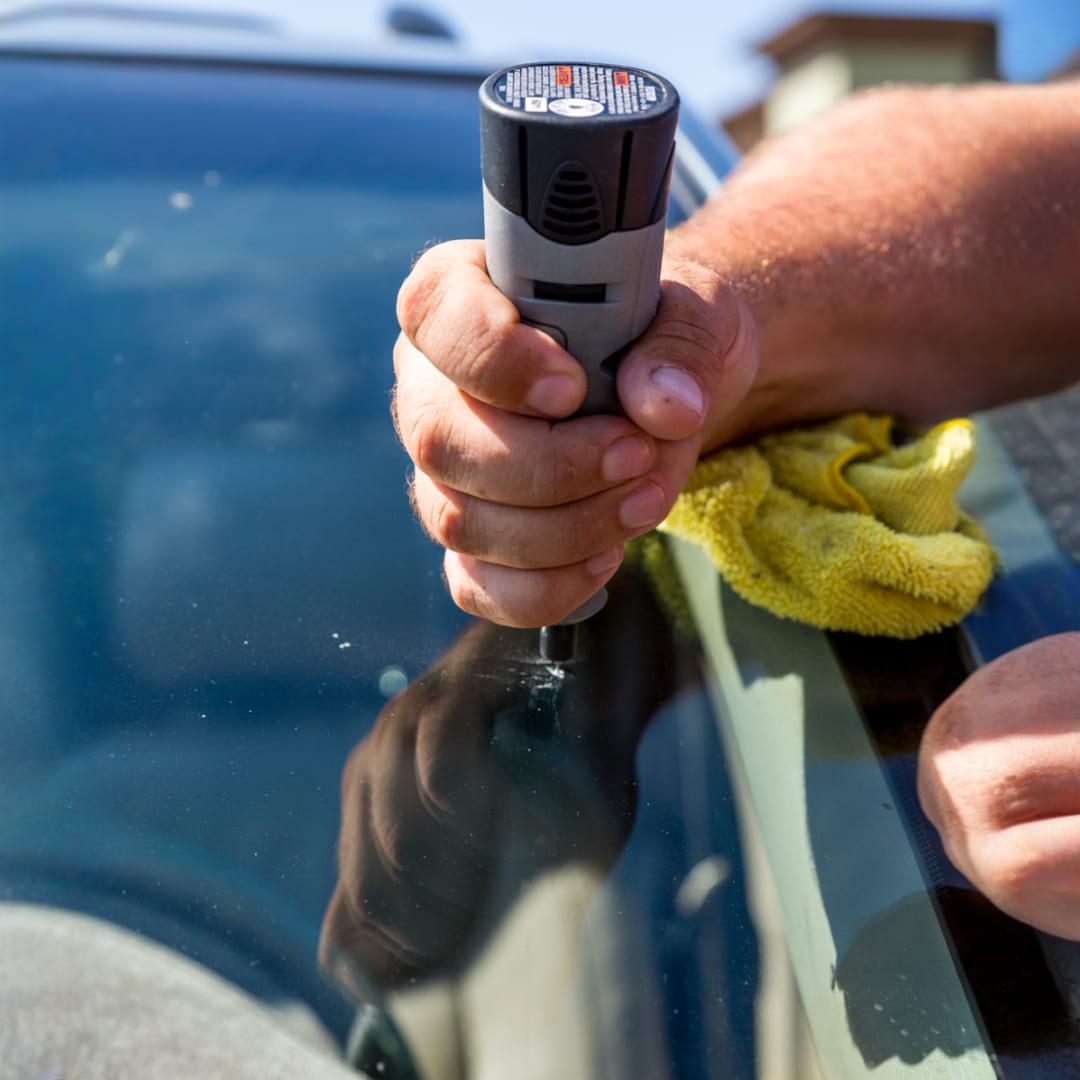
There is a specific afternoon on which your windshield stops being repairable, and you will almost certainly drive straight through it without noticing. Nothing happens. No sound, no new damage in the mirror. The chip that a technician could have filled in a quarter of an hour simply crosses some invisible line and becomes a piece of glass that has to come out of the car.
That line moves faster in Arizona than almost anywhere else in the country, which is the whole reason this is worth reading. The advice you find written for drivers in Ohio or Oregon assumes you have a season to think it over. Here you have weeks, and in July you sometimes have days. What follows is what actually pushes a chip past the point of repair, in the order that it matters.
What is really happening inside the glass
A windshield is not one piece of glass. It is two thin layers with a sheet of plastic laminated between them, bonded under heat and pressure into something that holds together when it breaks instead of falling into your lap. When a rock hits it, the outer layer fractures and the plastic interlayer stops the damage going any further. What you see as a star or a bullseye is a small pocket of crushed glass and trapped air sitting on top of that plastic.
A repair works by pulling the air out of that pocket under vacuum and pushing an acrylic resin in to take its place, then curing the resin under ultraviolet light so it bonds to the glass around it. It works beautifully while the pocket is clean and the crack legs are short. It stops working once the legs run too far to fill, or once dirt, wax and water have worked their way into the void and the resin has nothing clean to grip.
Your eyes are doing more work than you notice
Most people judge a chip by whether it bothers them, which is the wrong test. Sitting still in a driveway, a small star in the passenger side of the glass is easy to ignore. On the road at speed, with low sun coming through it at an angle, the same star scatters light across your field of view and your eyes quietly work harder to compensate.
The effect is worse for anyone over about forty, whose eyes already take longer to recover from glare, and it is worse again on the drive home in winter, when the sun sits low and directly in front of you on an east to west commute. You do not notice yourself squinting. You notice that you are more tired than the drive should have made you.
Arizona heat is running an experiment on your windshield
This is the reason the repair window is shorter here, and it is worth understanding properly rather than accepting as folk wisdom. Glass expands when it warms and contracts when it cools. Your windshield is fixed around its whole perimeter in urethane, so it cannot expand freely, and the stress has to go somewhere. Existing damage is the weakest point, so that is where it goes.
In a Phoenix summer, a car parked outside can reach surface temperatures on the glass well above air temperature, then drop thirty degrees or more overnight. That cycle repeats every day for months. Several ordinary habits make it considerably worse:
- Running the air conditioning on maximum straight onto a windshield that has been baking in a parking lot all afternoon.
- Pouring water over the glass to cool it down or clear dust, which is the fastest way to run a crack across an entire windshield.
- Parking so that half the glass sits in shade and half sits in direct sun, which puts the two halves at genuinely different temperatures.
- Slamming doors on a sealed cabin, which spikes the pressure inside the car against a windshield that is already under stress.
None of these will break healthy glass. All of them will extend a crack that has already started.
The law has an opinion about this
Arizona does not have a rule that says a crack of a particular length is illegal, which is where a lot of confusion comes from. What it has is a requirement about your view of the road. Under ARS 28-957.01, damage that obstructs the driver's clear view is a violation, and whether yours qualifies is a judgement an officer makes at the roadside rather than something you can measure in advance.
Two related statutes matter as well. ARS 28-956 requires two functioning mirrors if the windshield is damaged or missing, and ARS 28-959 requires that any replacement glass meets federal safety glazing standards, which is one practical reason to be careful about who installs it. A citation is the visible risk. The less visible one shows up after a collision, when the condition of the vehicle becomes part of the conversation about liability.
The money is not close
A chip repair is a small job. A replacement is a different category of work, and on a modern car it brings a second job with it. Once the glass comes out, any vehicle with a forward facing camera behind the mirror needs that camera recalibrated, because moving the glass moves the camera's reference point. That is not an upsell, it is what makes lane keeping and automatic emergency braking aim correctly afterwards.
Standard windshields generally run between two hundred and fifty and four hundred dollars. Specialty and luxury glass, or vehicles that require manufacturer specific parts, run from five hundred to a thousand. Side and rear windows fall between two hundred and four hundred and fifty. Against those numbers, a fill you booked the week the rock hit is a rounding error, and it is frequently free. Which brings us to the part most people get wrong.
Your policy may already have paid for this
Arizona is one of a small number of states with a genuinely favourable rule here. Under ARS 20-264, an insurer offering comprehensive coverage in this state has to make full safety glass coverage available with no deductible if the customer selects it. Plenty of drivers are carrying that option without knowing, because it was ticked at some point and never thought about again.
The practical effect is that a repair often costs the driver nothing at all, and a replacement often costs nothing either. Glass claims also sit under the comprehensive part of a policy rather than the collision part, which insurers treat differently from an at fault accident.
What to have in front of you when you call
Having these four things ready turns a benefits check into a two minute conversation rather than a callback:
- Your insurer's name and your policy number.
- The year, make and model of the vehicle, and the trim if you know it, since trim decides whether there is a camera behind the glass.
- Roughly when and how the damage happened.
- Where the vehicle will be parked for the appointment, because that decides how the job gets scheduled.
If it turns out you do not carry the glass option, ask about adding it afterwards. It is inexpensive, and in a state where the roads throw this much gravel it tends to pay for itself.
The cheapest version of this problem is the one you fix this week
Nothing about a windshield chip feels urgent, and that is precisely the trap. It sits there looking harmless for a fortnight, and the entire time the glass around it is being flexed by the daily temperature swing, worked on by highway vibration and slowly contaminated by road film. The repair stays possible right up until it does not, and there is no warning on the day it stops.
If there is a star or a bullseye in your glass right now, the useful thing to do is find out this week whether it can still be filled, and whether your policy covers it. Our chip and crack repair service exists for exactly this window, and where the damage has already run too far, windshield replacement comes with camera recalibration handled in the same visit. Either way it happens where the car is already parked, and the answer to the question costs you a phone call.
