Take the engine out of a car and something unexpected happens to the windshield. It gets louder. Not physically, but in the sense that every small imperfection in how it was fitted is suddenly audible, because the sound that used to cover it has gone.
That is the honest starting point for anyone about to have glass work done on a Tesla or any other electric vehicle. The job is not harder in some mysterious way. It is simply less forgiving, for two reasons that are worth understanding before you choose who does it.
Silence is an unforgiving test
In a car with a combustion engine, a windshield that sits a fraction proud on one side, or has a small gap in the urethane bead near the A pillar, produces a wind whistle at freeway speed that most drivers never notice. The engine, the transmission and the exhaust are all producing more noise than the leak is.
Remove all of that and the cabin gets quiet enough that road noise and wind noise become the dominant sounds. A whistle that was inaudible in a pickup is obvious in an electric sedan at sixty five miles an hour, and once you have heard it you cannot stop hearing it. This is the single most common complaint after an EV windshield replacement, and it is almost always a fitment issue rather than a glass issue.
It also explains why the factory glass is usually acoustic laminated, with a sound damping layer built into the interlayer. Fit ordinary glass in place of acoustic glass and the car will be measurably noisier than it was, and the owner will notice on the drive home. Matching the original specification matters more here than on almost any other vehicle type.
The cameras are doing the driving
The second difference is more consequential. Tesla's driver assistance runs on cameras rather than radar, which means the forward facing camera assembly behind the mirror is not assisting a sensor suite, it is the sensor suite.
Every other manufacturer's approach has some redundancy in it. A radar unit behind the badge keeps working regardless of what happens to the windshield. On a camera led system there is no second opinion. Whatever the camera sees through that glass is what the car believes about the world, which puts the optical quality of the windshield directly into the safety path.
That has a practical consequence people underestimate. Aftermarket glass with slight distortion near the top edge, which would be invisible to a human and harmless on most cars, sits directly in the camera's field of view. It can degrade what the system reads, and in some cases it makes calibration difficult or impossible to complete.
What recalibration involves on a camera led car
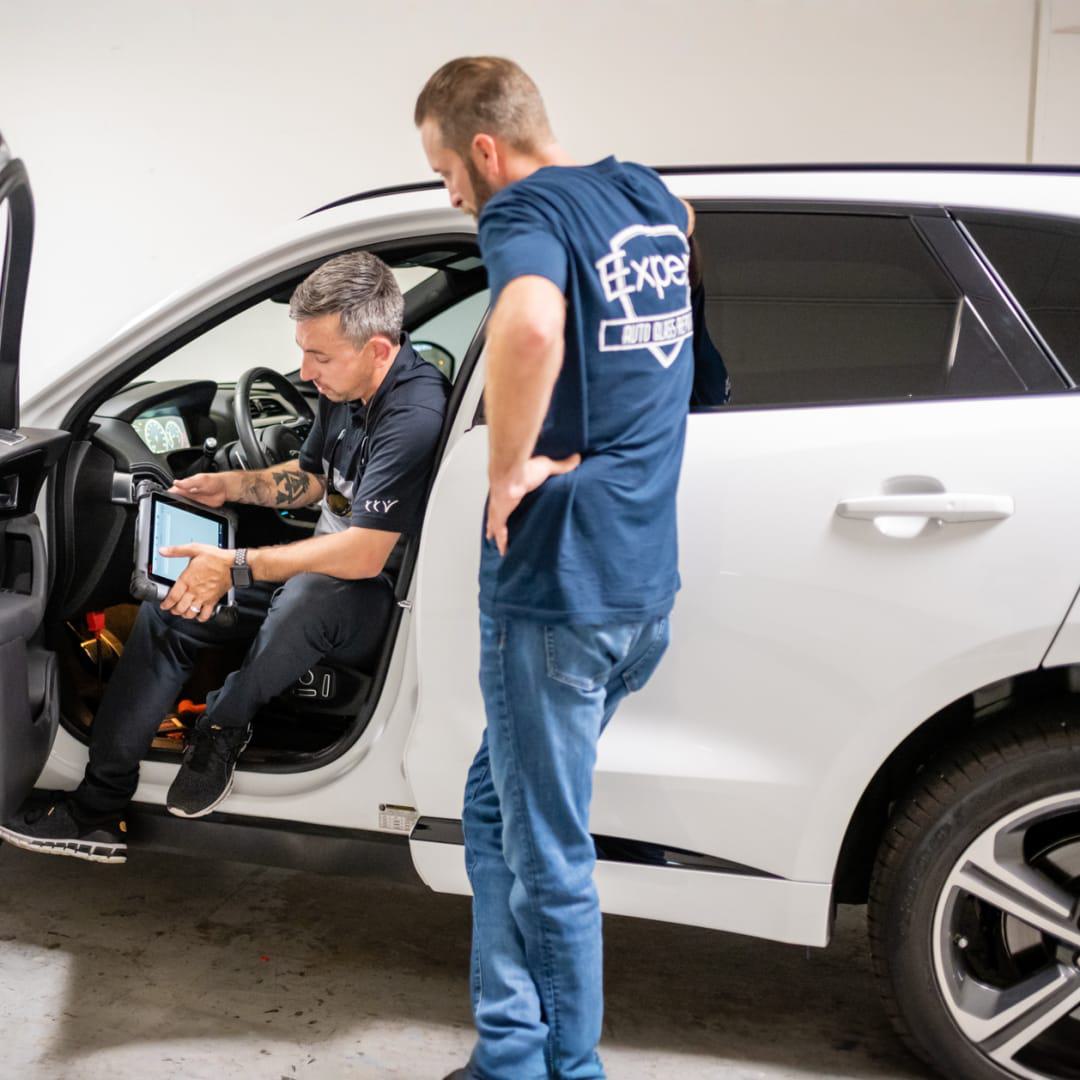
Any vehicle with a forward camera needs recalibration after a windshield replacement, because taking the glass out and putting new glass in moves the camera's reference point by a small amount. On a camera led system that step is not a formality.
The procedure differs from the target board process used on many vehicles. These systems generally relearn by driving, using clearly marked roads at a steady speed so the cameras can re-establish their reference against lane markings and known geometry. That means the calibration is not finished when the technician packs up, it completes over a period of driving afterwards, and the car will usually tell you it is in progress.
Two things follow from that. First, the drive matters, so well marked highway miles complete it faster than stop start city driving. Second, if the calibration does not complete, that is information rather than a nuisance. It frequently points at the glass, and it is the reason fitting the correct specification is worth the difference in price.
The glass itself is a bigger object than you think
Physically, these windshields are large. The raked, deeply curved design used across the current generation of electric vehicles puts more glass area in front of the driver than a comparable sedan from a decade ago, and the panel extends further back over the cabin.
Size has consequences on the day. A large curved panel needs two people and proper setting cups to place accurately in one controlled motion, because there is no adjusting it once it touches the bead. It is also more expensive to buy and more vulnerable in transit, so availability can be less predictable than for a mainstream sedan.
It is worth being clear about one point of confusion, because it comes up constantly. On several models the glass roof is a separate panel from the windshield. Damage to the roof is a different part, a different job and a different price. If you are getting a quote, be specific about which piece of glass is damaged.
What actually causes damage on these cars
Nothing exotic. The same gravel that hits everything else, with a few characteristics that make it slightly more likely to matter:
- Instant torque means these cars accelerate away from lights quickly, which changes the closing speed on debris thrown by traffic ahead.
- They are quiet enough that a rock strike is genuinely startling, and owners tend to notice the exact moment it happened.
- The steeper rake presents more glass to material arriving on a shallow trajectory.
- Large glass area simply means more target.
None of that makes the glass weaker. It is laminated to the same principle as any other windshield, with an outer layer, a plastic interlayer and an inner layer.
Chip repair is still the right answer when it fits
There is a persistent belief that a chip in one of these windshields automatically means replacement. It does not. A resin repair works on the same physics regardless of what is powering the car, and given what the glass costs, a fifteen minute repair is a far better outcome.
The one genuine restriction is position. Because the camera assembly sits behind the mirror and reads through the glass, damage in that zone is treated more strictly than it would be on a radar equipped car. A chip that might be repairable on another vehicle can require replacement here, purely because of where it landed. Away from that area, the ordinary rules apply, and our chip and crack repair service handles them the same way it handles any other vehicle.
Questions worth asking before you book
Whoever you use, these four answers tell you most of what you need to know:
- Are you fitting acoustic glass matching the original specification, and can you confirm that from the part number?
- How do you handle the camera calibration, and what happens if it does not complete?
- Do you have two technicians for the set, given the size of the panel?
- What is the safe drive away time you will give me, and does the calibration drive happen before or after it?
A shop that answers those clearly has done this before. A shop that treats it as an ordinary windshield with a bigger price tag probably has not.
Quiet cars reward doing it properly
Everything about glass work on an electric vehicle comes back to the same idea. The margins are narrower. A slightly imperfect bead becomes an audible whistle instead of an inaudible one. Slightly imperfect optics become a calibration problem instead of a cosmetic one. Slightly wrong glass makes the cabin noisier in a car whose quietness is part of why you bought it.
The work itself is not exotic and the cost difference between doing it correctly and doing it cheaply is smaller than most people expect, particularly in Arizona where a great many drivers already carry glass coverage they have never used. If you are looking at damage now, our windshield replacement service covers the correct glass, the set and the camera recalibration in one appointment, wherever the car happens to be parked.
