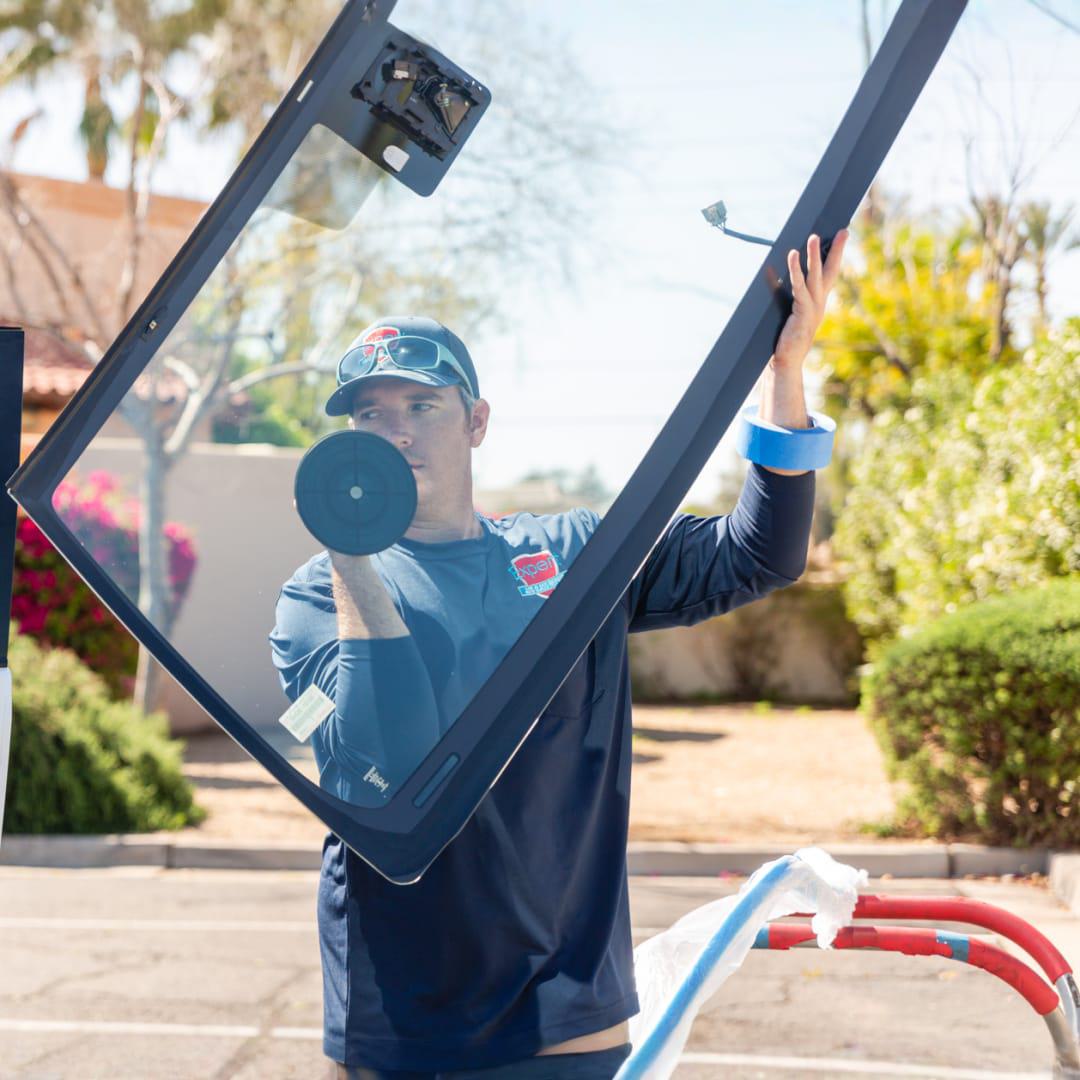
Nobody plans for the back window. A windshield gets attention because you look through it all day, but the rear glass sits behind you doing several jobs at once, and most drivers only find out what those jobs were on the morning it is lying in the trunk in a thousand pieces.
That morning tends to come with two questions arriving together. What does this cost, and will insurance handle it. The answers are more favourable than people expect in Arizona, but they depend on details that are easy to get wrong, and the wrong move costs real money.
Why the back window is a different animal
Your windshield is laminated, two sheets of glass bonded to a plastic interlayer, which is why it cracks and holds together rather than falling apart. Rear glass is almost always tempered instead. It is heat treated so that when it fails it releases into thousands of small, relatively blunt cubes rather than long shards.
That difference has two consequences. The first is that tempered glass cannot be repaired. There is no laminate holding fragments in position, so there is nothing for resin to bond into. A damaged rear window is a replacement, always, with no judgement call to make. The second is that when it goes, it goes completely and suddenly, often hours after the impact that caused it, which is why people report windows failing in a parking lot with nobody near the car.
What is actually built into that piece of glass
This is where the cost comes from, and it is worth understanding before you look at a quote and assume you are being overcharged. Rear glass is rarely just glass:
- The defroster grid. Those fine horizontal lines are a printed heating element with electrical connections at both sides. They have to be reconnected and tested.
- The radio antenna. On a great many vehicles the AM and FM antenna is printed into the rear glass alongside the defroster, so a bad installation costs you radio reception.
- The third brake light. On many hatchbacks and SUVs this mounts to or through the glass and has to come off and go back on.
- The rear wiper. Where fitted, the motor spindle passes through the glass and needs sealing correctly or you get a leak directly above the load space.
- Factory tint. Rear privacy glass is usually tinted in manufacture rather than filmed afterwards, so the replacement has to match or the car looks wrong from behind.
None of that is exotic, but all of it is work, and it is why rear glass quotes vary more between vehicles than windshield quotes do.
The cleanup is half the job
Here is the part that separates a proper installation from a cheap one, and it is invisible on the invoice. When tempered glass fails, the fragments do not stay where they fell. They go down inside the tailgate or the quarter panel, into the seat rails, under the parcel shelf, into the spare wheel well, and into the carpet where they work their way into the pile.
Fragments left in the tailgate rattle for the life of the car. Fragments in the seat rails end up in a passenger's hand. Fragments in the carpet come out one at a time for two years. A rear glass job done properly involves a great deal of vacuuming in places that are awkward to reach, and if a quote seems unusually low it is worth asking directly how the cleanup is handled.
How the insurance side actually works
Glass damage sits under the comprehensive part of an auto policy, not the collision part. Comprehensive is the section covering theft, vandalism, weather and falling objects, which is where almost all rear glass damage comes from. If you carry comprehensive, you very likely have some cover for this.
Arizona then adds something genuinely useful on top. Under ARS 20-264, an insurer offering comprehensive coverage in this state has to make full safety glass coverage available with no deductible where the customer selects it. A lot of drivers carry that option without realising, because it was chosen once and never revisited. Where it applies, the replacement can cost the driver nothing.
When filing is the wrong move
Filing is not automatically correct, and a shop that pushes you to claim without asking about your deductible is not doing you a favour. The arithmetic is simple. If your comprehensive deductible is five hundred dollars and the replacement is three hundred and twenty, filing achieves nothing except putting a claim on your record. If you carry the zero deductible glass option, filing costs you nothing and you should absolutely use it.
The only way to know which situation you are in is to check before the work is booked, which takes one phone call. We do that check with customers as a matter of course rather than after the fact, and you can read how the Arizona zero deductible glass benefit works in more detail.
Filing a rear glass claim without the friction
Claims stall for boring reasons, almost always documentation. A few things make the process go smoothly:
- Photograph the damage before anything is cleaned up, including a wide shot showing the whole vehicle.
- Report it promptly, because carriers ask when it happened and long gaps invite questions.
- Use a shop that bills carriers directly and knows the documentation each one wants.
- Get the estimate in writing with the parts itemised, so the adjuster is not guessing.
- Keep the claim number somewhere you can find it, because you will be asked for it more than once.
One thing worth knowing: your insurer may recommend a shop from their network, but in Arizona the choice of who repairs your vehicle is yours. Telling an adjuster you have already selected a shop is a normal, unremarkable thing to do.
Driving with the back window out
People do this, usually with a plastic sheet taped over the opening, and usually for longer than they intended. It is worth being clear about the costs. Your rear visibility is gone, which matters most when reversing and changing lanes. Rain gets in and soaks the parcel shelf and carpet, which in a closed car in Phoenix heat becomes a mould problem quickly. The car is trivially easy to enter, so anything left inside is effectively unsecured. And plastic sheeting flaps at speed, which is both distracting and unreliable.
Under ARS 28-956, if the windshield is damaged or removed you are required to have two functioning mirrors. Rear glass sits differently in the statutes, but the practical safety argument stands on its own. Same day or next day rear window replacement is usually available, which makes the tape and plastic route hard to justify beyond the first night.
The part that decides whether this goes smoothly
Rear glass is a straightforward job for someone who does it regularly and a frustrating one for everyone else. The glass itself is easy to source and quick to fit. The circuits, the seals and the cleanup are where the quality shows up, and none of them are visible when you collect the car. What you notice, three months later, is either nothing at all or a rattle in the tailgate and a defroster that clears two thirds of the window.
So the useful sequence is short. Photograph it, call your insurer and ask specifically whether you carry the Arizona glass option and what your comprehensive deductible is, then book a shop that will tell you plainly what is printed into your particular piece of glass and how they intend to get the fragments out. That last question tells you almost everything about who you are dealing with.
